
Explore the history of the stethoscope, from ancient listening techniques to René Laennec’s 1816 invention and today’s digital devices. Learn how stethoscopes work, how they evolved, and why they remain an essential assessment tool for nurses in modern healthcare.

When we think of a nurse, the image conjured in our minds is likely a person in scrubs with a stethoscope around their neck. The stethoscope is more than a tool; it’s a symbol of healthcare and the relationship between clinician and patient. Its name is derived from the Greek stethos for chest and skopein for to look.
Explore the history of the stethoscope, from ancient listening techniques to modern digital devices, as well as how the instrument works and why it remains an essential part of nursing practice.
Listening to Breath Sounds
Since ancient times, people have listened to breath sounds to gauge a person’s health. It typically involves using a tool to listen to a person’s lungs, heart, and intestines. Sounds are evaluated for frequency, intensity, duration, and quality.
Auscultation Defined
Auscultation refers to the act of listening to internal body sounds for diagnostic purposes, according to MedlinePlus. Immediate auscultation involved the physician’s ear directly on the patient, which could be awkward and imprecise. Mediate auscultation, which uses an instrument between the patient and examiner, would transform medical practice.
Ancient Techniques: Inspection, Percussion and Early Auscultation
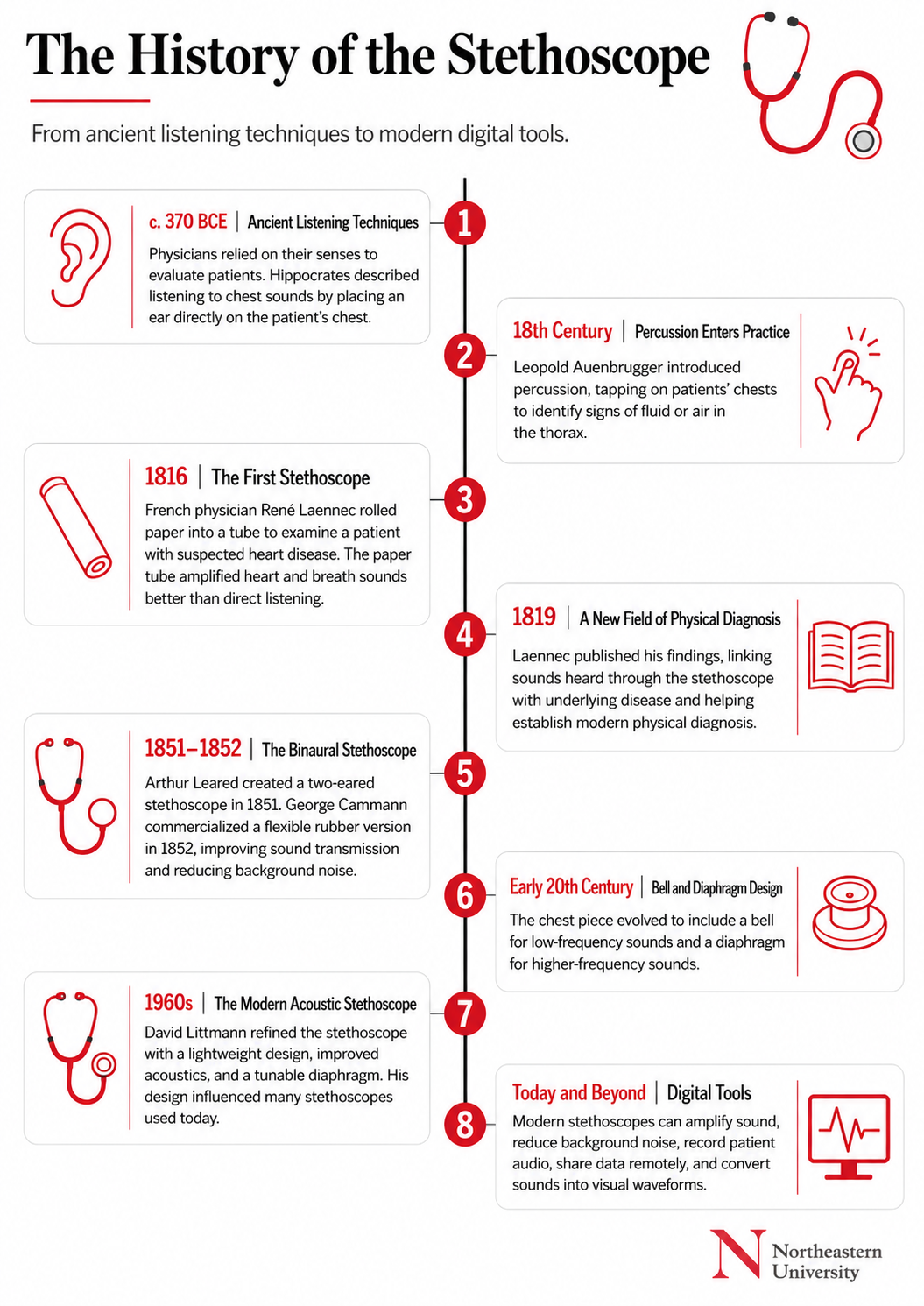
Long before stethoscopes existed, physicians relied on their senses to assess patients. Hippocrates (c. 370 BCE) described listening to chest sounds by placing an ear directly on the patient’s chest. Another ancient diagnostic method was percussion, introduced in the 18th century by Viennese physician Leopold Auenbrugger. He tapped on patients’ chests the way his innkeeper father tapped wine barrels, interpreting the resulting sounds to identify fluid or air in the thorax.
H2: The Origin of the Stethoscope
The invention of the stethoscope is credited to French physician René Laennec in 1816, according to Cureus. The often‑told story describes how Laennec was asked to examine a young woman suspected of heart disease. He found it inappropriate to press his ear against her chest, so he rolled a piece of paper into a tube and placed one end on her chest and his ear against the other.
The improvised paper cylinder amplified heart and breath sounds better than direct listening. Recognizing the potential of mediate auscultation, Laennec fashioned a hollow wooden tube with a funnel at one end and named it the stethoscope.
Laennec did more than invent a device; he correlated the sounds he heard with the underlying pathology seen at autopsy. He published his findings in 1819, providing clinicians with descriptions of normal and abnormal heart and lung sounds and establishing a new field of physical diagnosis.
The Evolution of the Stethoscope
The stethoscope’s design has changed a bit since it was invented, but the purpose has remained the same.
Early Designs and Innovations
Laennec’s original stethoscope was a single‑ear, or monoaural, instrument made of wood. By the 1820s, doctors across Europe were experimenting with different lengths, shapes, and materials to improve acoustics. Various types of wood, ivory, glass, and metal were used. Because tuberculosis and other contagious diseases were common, physicians sometimes preferred longer models to maintain distance from patients.
The next major step was the development of the binaural stethoscope. In 1851, Irish physician Arthur Leared created a two‑eared instrument; the following year, American doctor George Cammann commercialized a flexible rubber version with ivory earpieces. Binaural stethoscopes improved sound transmission by delivering sounds directly to both ears while blocking ambient noise, the article in Cureus says.
By the early 20th century, the stethoscope’s chest piece evolved to include a bell and diaphragm. A bell with a hollow cup was suited for low‑frequency sounds, while a flat diaphragm captured higher‑frequency sounds.
Today’s Version and How It Works
In the 1960s, Harvard cardiologist David Littmann refined stethoscope acoustics by patenting a lightweight device with improved sound transmission and a tunable diaphragm. The Littmann design is the basis for many of today’s stethoscopes and was purchased by 3M.
The traditional stethoscope remains a simple yet effective acoustic instrument. It has three main components: a chest piece, hollow tubing, and metal ear tubes. When the chest piece is placed on the skin, internal vibrations like the “lub‑dub” of heart valves or the whoosh of breathing cause the diaphragm to vibrate.
These vibrations travel through the air column inside the tubing and into the clinician’s ears, as described by the Cleveland Clinic. The design allows clinicians to hear normal and abnormal sounds from the heart, lungs, intestines, and blood vessels.
Modern stethoscopes come in several types.
- Analog - rely on pure acoustics; sound travels through flexible tubing from the chest piece to the ears.
- Electronic - contain amplifiers that boost quiet or subtle sounds and reduce background noise.
- Digital - convert acoustic signals into electronic data that can be recorded, shared, or transformed into visual waveforms.
These advances make it possible to store patient recordings for comparison and to transmit data to remote specialists.

Why Northeastern's Accelerated Bachelor of Science in Nursing program is a great choice for your nursing degree.
Future Technologies
The stethoscope continues to evolve. In the late 1990s Canadian physician Richard Deslauriers worked with engineers at Bose Corp. to develop a recording stethoscope that could play back heart and lung sounds and filter out extraneous noise, Cureus reports.
More recently, researchers have designed foam pads embedded with sensors that can auscultate multiple chest wall locations simultaneously, called a stethograph system. It remains to be seen whether these advances will be incorporated into everyday healthcare practice.
Why the Stethoscope Is Essential in Nursing
Stethoscopes are a cost‑effective diagnostic tool. Even in high‑tech environments, a quick listen with a stethoscope can reveal crackles suggestive of pneumonia, wheezes indicative of asthma, or the absence of bowel sounds after surgery. The tool’s portability allows nurses to assess patients at the bedside, in community clinics or during home visits, without relying on power or advanced equipment.
Ultrasound and digital diagnostic tools are powerful but should augment, not replace, auscultation. For example, hand‑held ultrasound devices can visualize heart chambers and detect pericardial effusions, while digital stethoscopes can capture recordings for telehealth consultation. Both require training and can be expensive, however. Nurses must balance new technologies with foundational skills to ensure efficient, patient‑centered care.

Start Your Nursing Journey
Even as diagnostics advance, this simple instrument will likely remain a recognizable emblem of the nursing profession. For students entering Northeastern University’s Accelerated Bachelor of Science in Nursing (ABSN) program, mastering auscultation is part of embracing the skills and identity of a nurse.
If you hold a non-nursing degree or at least 62 credits, you could be eligible to complete Northeastern’s ABSN program in as few as 16 months.
Request information and connect with an admissions counselor to learn more.